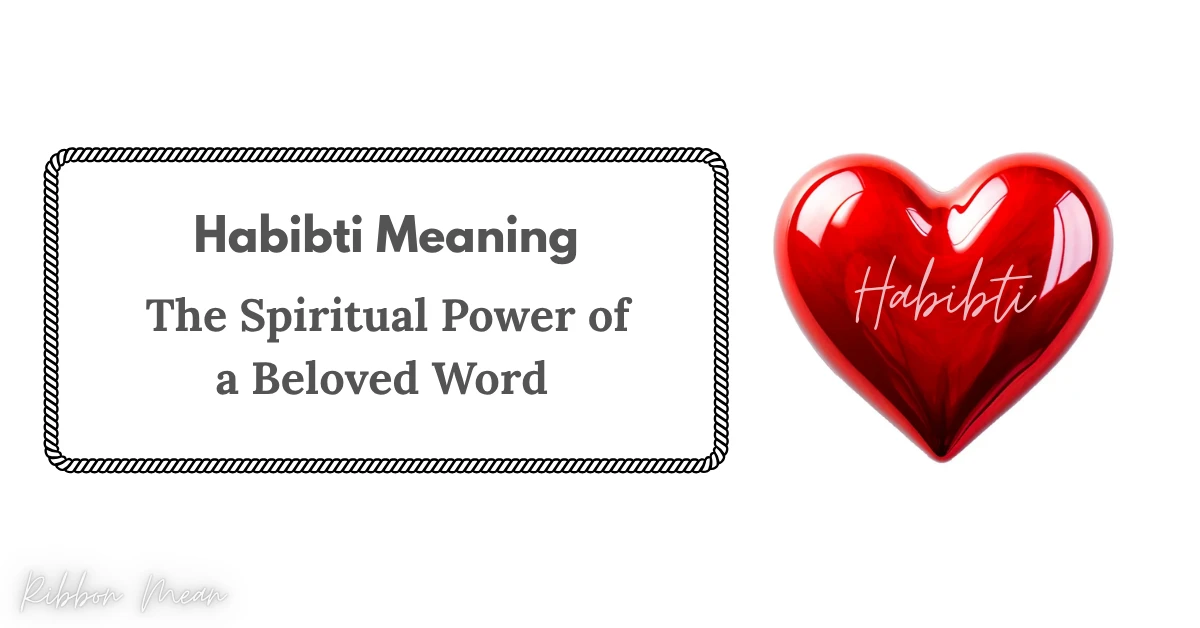
Habibti Meaning: The Spiritual Power of a Beloved Word
Someone called you habibti. Or you heard it and felt something unexpectedly warm move through you.
That warmth was not accidental. Habibti is not just a word. It is a spiritual declaration — one of the most tender, soulful, and divinely rooted expressions of love in any language on earth.
What Habibti Actually Means
Habibti (حبيبتي) is Arabic for “my love,” “my darling,” or “my beloved” — spoken specifically to a female.
The masculine form is Habibi (حبيبي) — used when addressing a male. Both words share the same sacred root and the same depth of meaning. Only the grammatical gender changes. The love behind the word does not.
The Sacred Root — Where the Word Comes From
Habibti is built from the Arabic root H-B-B (ح-ب-ب) — one of the most spiritually significant roots in the entire Arabic language.
This same root appears throughout the Quran to describe Allah’s love for His creation. The phrase “Indeed, Allah loves those who do good” uses this exact root. When a person says habibti to another human being, they are — consciously or not — echoing the same linguistic frequency used to describe divine love itself.
This is not metaphor. In Arabic, the language of love between people and the language of love between God and humanity share the same root word. That connection is deeply intentional in Islamic spiritual tradition.
The Spiritual Depth of Habibti
Love That Transcends the Romantic Habibti is used far beyond romance. Mothers say it to daughters. Friends say it to friends. Grandmothers say it to grandchildren. Teachers say it to students.
It is a word that crosses every relational boundary because it is not describing a type of love. It is describing a quality of love — deep, protective, soul-level care that sees the other person as genuinely precious.
A Declaration of Sacred Bond When someone calls you habibti, they are saying something spiritually profound — “You are held dear. You are safe with me. Your soul matters to mine.”
It carries the energy of peace, protection, and belonging all at once. In Islamic tradition, these three qualities — salaam (peace), himaayah (protection), and intima’ (belonging) — are considered among the most sacred gifts one human being can offer another.
Divine Love Reflected in Human Connection In Sufi mystical tradition, human love is understood as a direct reflection of divine love — a mirror through which the soul glimpses God’s own nature.
The Sufi poets — Rumi, Hafiz, Ibn Arabi — used the language of beloved and lover constantly as spiritual metaphor. The beloved was simultaneously the human love and the divine. Habibti, in this framework, is not just a term of endearment. It is a recognition of the divine in another person.
How Habibti Is Used Across Cultures
The Arab world spans over 22 countries — from Morocco to the Gulf — and habibti moves through all of them with the same warmth and weight.
In Egyptian Arabic, it flows constantly in everyday speech — between friends at cafes, mothers calling children, neighbors greeting neighbors. It is the texture of daily warmth woven into ordinary language.
In Levantine Arabic — spoken across Lebanon, Syria, Palestine, and Jordan — habibti carries particular emotional depth, often used in poetry, music, and the most tender moments of human connection.
In Gulf Arabic, it carries a more formal warmth — still deeply affectionate, but used with a specific awareness of its weight and meaning.
Across all these contexts — the word never loses its power. No matter how casually it is used, habibti always carries the full weight of its meaning. Some words are too rooted in something sacred to become truly ordinary.
What It Means When Someone Calls You Habibti
When a person chooses this word for you — they are placing you in the category of the genuinely beloved.
Not acquaintance. Not colleague. Not even just friend. Beloved. Someone whose presence is considered a gift. Someone whose wellbeing matters at a soul level.
In the spiritual economy of the Arabic-speaking world — being someone’s habibti is one of the most honored positions a person can hold in another’s heart.
Other Post: Broken Bird Egg Spiritual Meaning: Signs of Change and Renewal
Question’s
What exactly does habibti mean?
Habibti means “my love,” “my darling,” or “my beloved” in Arabic — used specifically when addressing a female. It comes from the root H-B-B, the same root used in the Quran to describe God’s love for humanity. It expresses deep, soulful affection that transcends romantic love — used between friends, family members, and loved ones across the Arab world.
How do Muslims say I love you?
The most direct expression is “Uhibbuka” (أحبك) when speaking to a male, or “Uhibbuki” (أحبك) when speaking to a female — both meaning “I love you.” A spiritually significant expression is “Ahabbaka alladhi ahbabtani fihi” — meaning “May the One for whose sake you love me also love you” — a blessed phrase from prophetic tradition that transforms the declaration of human love into a spiritual prayer. Saying habibti or habibi is also a deeply felt expression of love in daily Islamic and Arab life.
Can I call a woman habibti?
Yes — habibti is widely used across all types of relationships with women. It is appropriate between close friends, family members, romantic partners, and even colleagues in many Arab cultural contexts. Context and tone carry the meaning. In most Arab cultures, calling a woman habibti is a warm, affectionate, and deeply respectful expression — not limited to romance.
What does habibi mean in the Bible?
The Bible was not originally written in Arabic, so habibi does not appear in biblical text directly. However, the Hebrew word “Dodi” (דּוֹדִי) — used extensively in the Song of Solomon — carries nearly identical meaning: “my beloved.” Song of Solomon 2:16 states — “My beloved is mine and I am his.” The spiritual resonance between Arabic habibi and Hebrew dodi reflects the shared Semitic linguistic family and the universal human longing to name the one the heart holds most dear.
Conclusion
It is love rooted in the divine, expressed through the human, and felt in the soul. It has been spoken across centuries of Arab civilization — in prayers, in poems, in the quiet tenderness of ordinary moments between people who genuinely matter to each other.
If someone has called you habibti — you are not just liked. You are beloved. And that, in any language, in any tradition, in any spiritual framework — is one of the most sacred things one soul can say to another.

I’m Momin Ali, the admin of RibbonMean.com. I manage and review all informational content on the site, focusing on accuracy, clarity, and reliable sources. My goal is to provide well-researched ribbon meaning explanations readers can trust.